
Or equalization is the process of changing the balance of different frequency components in an audio signal.
In the process, a source’s volume level, frequency content, dynamics, and panoramic position are manipulated or enhanced.
<aside> 💡
If you wish to review the basic definitions of “frequency”, please refer to the Week 1 note section.
</aside>
Nearly every sound has a main frequency which is called the fundamental frequency.
This frequency is louder than all the other frequencies of the sound; you don’t really want to cut or mess with this!
This is usually the lowest frequency of a sound source, and is typically what we hear as the pitch of a sound.
When we relate this to voiceover, our unique and individual fundamental frequency is one of our voice’s most defining characteristics - to change this would be like trying to change our fingerprints or eye’s colour and pattern.
When either cleaning or getting creative with an EQ, we would ideally preserve this frequency, and arrange our EQ filters around it.
<aside> 💡
In this course we pay particular attention to the clean up aspect of engineering voiceovers, since we are primarily aiming these lessons at voice actors who wish to better understand and be able to achieve the best possible sound in their own recordings.
You can use EQ filters in a creative manner, to sculpt and mould your sounds and achieve some really unique flavours or colourful edits and tones, however we simply don’t have time to impart basic introductions and clean-up techniques AND creative applications of EQ filters.
</aside>
Harmonics, also called overtones, make up the rest of the sound spectrum outside of your fundamental frequency, which you can mess around with and put EQ on, etc. These are what give a sound its character and timbre.
Harmonics are how you are able to distinguish between a piano and saxophone, even when they’re played in the same key.

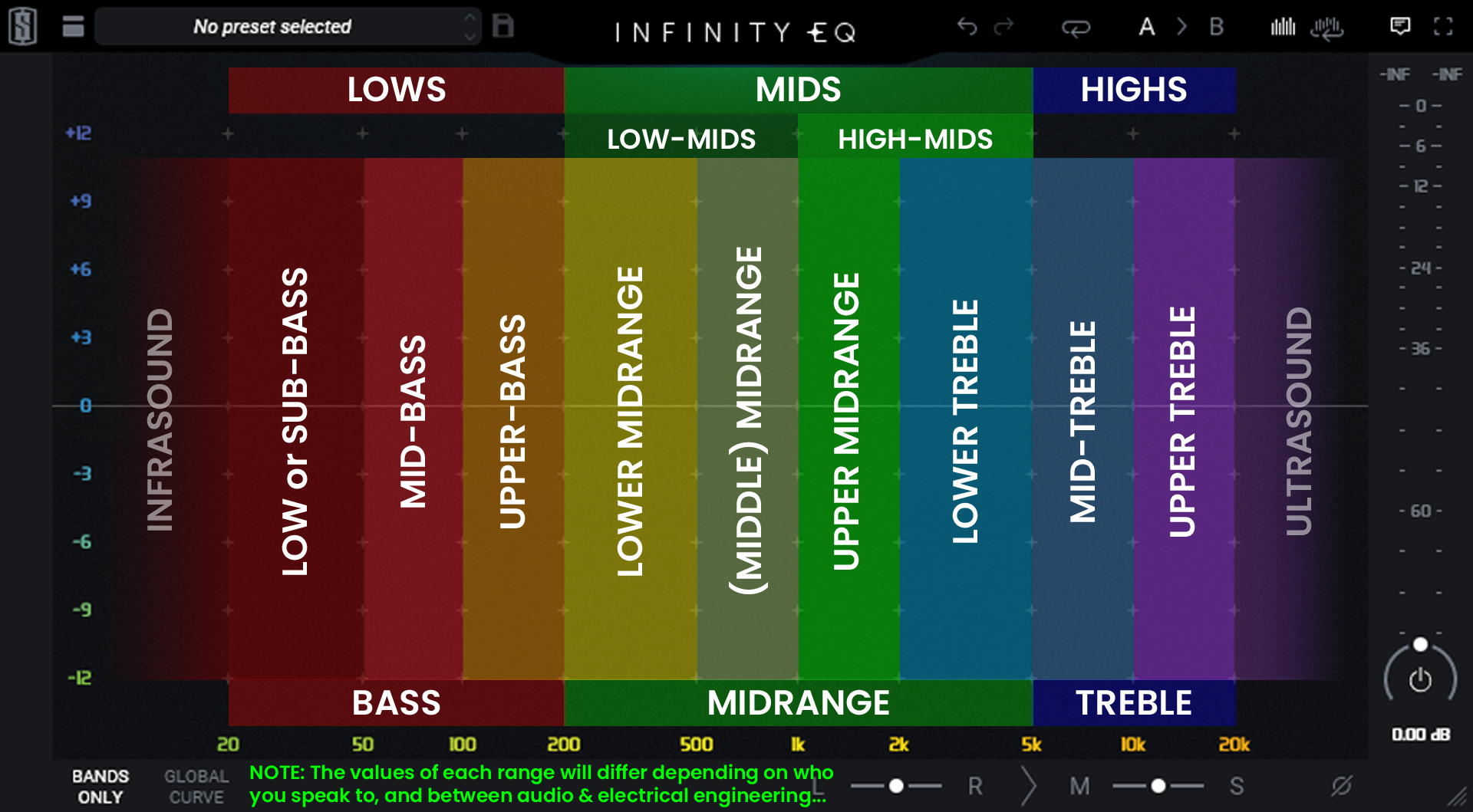
Reminder of the basic frequency ranges for voiceovers:
| Low End (”Lows”) | 20 Hz → 200 Hz |
|---|---|
| Mid-Range (”Mids”) | 200 Hz → 5 kHz |
| — Low-Mid | 200 Hz → 1 kHz |
| — High-Mid | 1 kHz → 5 kHz |
| High End (”Highs”) | 5 kHz → 20 kHz |
If you would like to see an expanded frequency range chart, please follow this link:
Preview:
In order to work with any EQ filter, you must first specific the frequency you want to manipulate. This is known as the central frequency, and depending upon the filter you choose will help determine the actual changes you will make to the signal.
In the context of an EQ filter, Gain controls how much of the selected (central) frequency is added or removed.